From idea to prototype in a day
One June morning, Shorewalk was a sentence on a whiteboard. That evening the app was on TestFlight. This is how we use rapid prototypes to validate concepts before anyone invests real money — in Kristiansand and beyond.
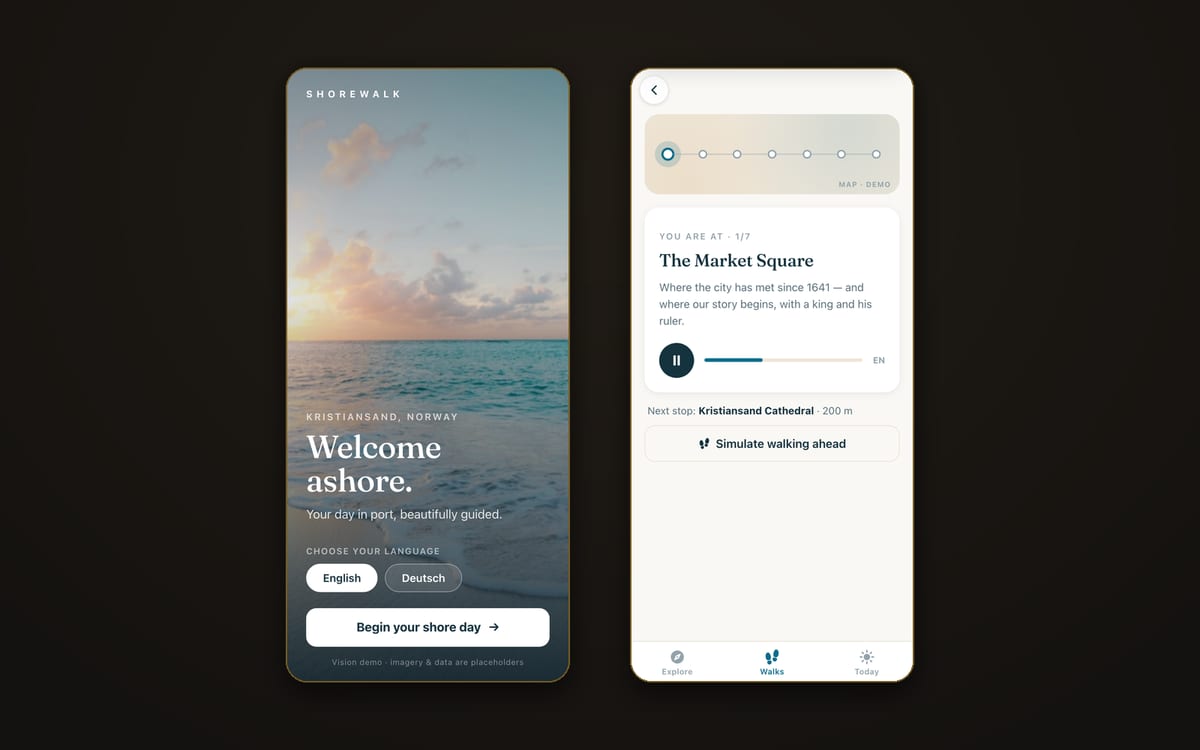
One morning in early June, Shorewalk was a sentence: “cruise tourists in Kristiansand should have a guide in their pocket.” That same evening, an app sat on TestFlight with a name, a brand, eleven screens, and an audio-guided walk through the old town. No backend, no database — but something a human can hold in their hand and have opinions about. That is the entire point.
The idea
Around 200,000 cruise passengers came ashore in Kristiansand in 2025. Most have a few hours, no plan, and unreliable mobile coverage. The concept: a QR code at the quay, an app with a free index of the city — and audio-guided walks that tell the stories as you go. Shore + walk. Instantly understandable in English and German, and it scales to any Norwegian port.
Why one day?
Because ideas are cheap right up until someone has to take a position on them. A slide deck invites a discussion about hypotheses. An app on someone's phone invites a discussion about the product: “the onboarding is too long,” “I would pay for this,” “it needs Danish.” Those are decisions, not opinions.
The second reason is cost. If the concept doesn't hold, you want to know after one day — not after three months and a six-figure invoice. A prototype that kills a bad idea has done its job exactly as well as one that confirms a good one.
What actually happened that day
Name checks first. The working title died on a trademark. Candidate two died on a competitor with a near-identical name in the App Store. Candidate three — Shorewalk — cleared trademark registers, the App Store, and domains. The domains were registered and the App Store name reserved the same morning. One hour of boring searches that saves months of rebranding.
Then the brand. We ran three rounds of AI-assisted exploration on the app icon: six divergent concepts, convergence around what worked, and a final integration pass. The result is a gold S on a petrol-blue field where a cruise ship, its route, and a southern Norwegian town tell the product story in a single glyph.
Then the app itself: Ionic Capacitor, one codebase for iOS and Android — the same stack we run other apps on in production. Eleven screens, real navigation, simulated data. A welcome screen, an explore tab, walk mode with an audio player and geofence notifications. Finally: build, signing, upload to TestFlight. The evening was still young.
What a vision demo is — and isn't
Let's be honest about what this is. There is no server. The data is handwritten. The purchase flow is a stage prop. Every screen carries a small footnote saying “vision demo.” It is not going to production — its job is to communicate the product precisely enough that decisions can be made.
But the choices that matter are real. Offline-first, because cruise tourists don't have roaming. Geofence notifications that work without coverage. Audio designed for a speaker in a busy summer street. Those are product decisions that survive into the real build — made while they were still cheap to change.
What this means for you
This is how we like to start an engagement. If you have an idea for an app or a web service — in Kristiansand or anywhere else — the first thing we propose is rarely a big project. It's a prototype: one day, maybe a week, with a concrete result you can hold in your hand, show your board, or put in front of real users. Then we both know what we're talking about before anyone commits to the long run.
Shorewalk is moving on toward a summer-season test. Your idea can get the same treatment.